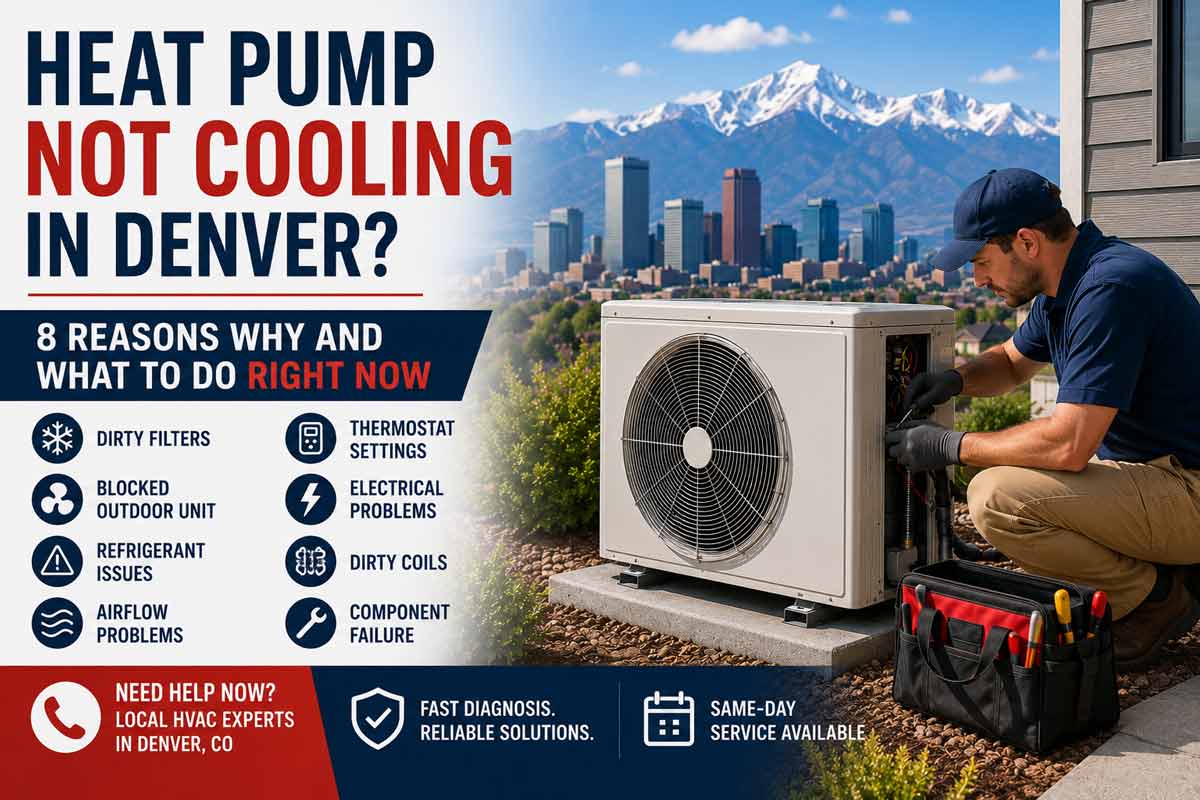
Heat Pump Not Cooling in Denver? 8 Reasons Why and What to Do Right Now (2026)
Your heat pump ran perfectly all winter. Now it's June, Denver temperatures are climbing into the 90s, and your system is running — but your home isn't cooling down. This is one of the most frustrating HVAC situations a homeowner can face, and it's more common in Denver than most people realize.
The good news is that not every heat pump cooling problem requires an expensive repair or full replacement. Several of the most common causes have straightforward fixes you can work through yourself in the next 10 minutes. Others require a licensed technician — and knowing the difference can save you both time and money.
This guide covers the 8 most likely reasons your heat pump isn't cooling in Denver, what each problem costs to fix, and exactly when to call for same-day service.
Why Heat Pump Cooling Problems Are Different From Standard AC Problems
Before diving into the list, it's worth understanding why a heat pump that won't cool needs to be treated differently from a standard central AC that won't cool.
A heat pump uses a reversing valve to switch between heating and cooling mode — a component that standard AC units simply don't have. This means heat pumps have a unique set of failure points that a technician unfamiliar with heat pump systems may misdiagnose. This is one of the key reasons Elite HVAC Co recommends using a heat pump specialist rather than a general HVAC technician for cooling problems — particularly if your system is a Mitsubishi or Trane unit where authorized dealer service is required to maintain your manufacturer warranty.
If your heat pump cooling problem turns out to require professional attention, our heat pump repair page covers what to expect from the service process and how Elite HVAC Co approaches diagnosis.
How to Confirm Your Heat Pump Is Actually in Cooling Mode
This sounds obvious — but it's the single most overlooked cause of heat pumps that appear not to cool. Before assuming something is wrong with your system, verify the following at your thermostat:
The system is set to COOL — not HEAT, AUTO, or FAN ONLY
The set temperature is below the current room temperature
The fan setting is set to AUTO rather than ON — fan only mode circulates air without cooling it
No scheduled override or vacation mode is active that might be holding a higher temperature set point
If you have a smart thermostat, check the app for any active schedules, modes, or geofencing settings that might be preventing the system from cooling. A significant number of heat pump cooling calls turn out to be thermostat setting issues — and catching this yourself saves a service call entirely.
8 Reasons Your Heat Pump Isn't Cooling in Denver
1. Dirty or Clogged Air Filter
The most common cause of poor heat pump cooling performance in Denver — and the easiest to fix yourself. Denver's dry, dusty climate combined with cottonwood season means air filters accumulate debris faster than in most other US cities. A severely clogged filter chokes airflow through the indoor unit, dramatically reducing the volume of cooled air reaching your living spaces and forcing the system to run constantly without achieving your set temperature.
DIY fix: Check your filter immediately. If it's grey, clogged, or visibly dirty — replace it. This takes 5 minutes and costs $10 to $30.
If the system still doesn't cool after a filter replacement, work through the remaining items on this list.
2. Clogged or Dirty Condenser Coils
Your heat pump's outdoor condenser unit releases heat from your home into the outside air during cooling mode. In Denver, cottonwood fibers, dust, and yard debris can coat the condenser coils within weeks — particularly during May and June when cottonwood season peaks. A coil that can't release heat effectively forces the system to run constantly without reaching your set temperature, while the compressor works under elevated stress.
DIY fix: With the power switched off at the outdoor disconnect box, gently rinse the condenser coils from the inside out using a garden hose on low pressure. Never use a pressure washer — it bends the aluminum fins and permanently reduces airflow. Clear all debris from around the unit and ensure at least 18 to 24 inches of clearance on all sides.
Professional coil cleaning cost in Denver: $100 to $300 as part of a professional tune-up service.
3. Reversing Valve Failure
This is the most heat-pump-specific cause on the list — and one that catches many Denver homeowners off guard. The reversing valve is the component that switches your heat pump between heating and cooling mode. When it fails partially or completely, the system may continue running but stay stuck in heating mode — blowing warm air regardless of what your thermostat says.
Signs of a failing reversing valve:
System blows warm or room-temperature air in cooling mode
System cools in heating mode
Hissing sound from the outdoor unit when switching between modes
System heats correctly but won't cool at all
This repair requires a licensed heat pump technician — reversing valve replacement is not a DIY fix. Contact Elite HVAC Co's heat pump repair service for same-day diagnosis and repair in Denver.
Repair cost in Denver: $300 to $1,200 depending on the system and parts availability.
4. Low Refrigerant — Leak or Undercharge
Refrigerant is the substance that actually transfers heat out of your home in cooling mode. If your system is low on refrigerant — almost always due to a leak rather than normal consumption — it loses its ability to cool effectively. You may notice the system running constantly, ice forming on the refrigerant lines or indoor coil, or air from the vents that feels only slightly cool rather than cold.
Denver's altitude makes refrigerant charge levels more critical than in other markets — even a slightly low charge that might be manageable at sea level can meaningfully reduce cooling capacity at 5,280 feet.
Signs of low refrigerant:
Ice on the refrigerant lines or indoor coil
Hissing or bubbling sounds near the unit
Vents blowing slightly cool but never reaching set temperature
Higher than normal energy bills despite reduced cooling
Refrigerant handling requires EPA Section 608 certification — never attempt this yourself. Call Elite HVAC Co at (720) 806-4774 for same-day refrigerant diagnosis and recharge.
Repair cost in Denver: $200 to $1,500 depending on leak location and severity.
5. Frozen Evaporator Coil
Your heat pump's indoor evaporator coil absorbs heat from the air inside your home during cooling mode. When airflow is restricted — by a dirty filter, blocked vents, or low refrigerant — the coil can drop below freezing and ice over completely, stopping the cooling process entirely.
A frozen coil is one of those problems that looks alarming but often has a simple root cause. The ice itself is a symptom, not the underlying problem.
Signs of a frozen evaporator coil:
System running but no airflow from vents
Ice visible on the indoor unit or refrigerant lines
Water dripping or pooling near the indoor air handler
DIY first step: Turn the system off at the thermostat and switch the fan to ON to circulate air and thaw the coil. Check and replace the air filter. Once thawed — usually 2 to 4 hours — restart the system in cooling mode. If it freezes again, there's an underlying cause that needs professional diagnosis.
Repair cost in Denver: $150 to $600 depending on root cause.
6. Capacitor Failure
Capacitors are small cylindrical electrical components that start and run your heat pump's compressor and fan motors. They're one of the most commonly replaced parts in Denver HVAC systems, particularly after summer power surges — which are common during Colorado's afternoon thunderstorm season.
A failed run capacitor prevents the compressor or outdoor fan from starting — leaving you with a system that hums, clicks, or attempts to start but can't complete the startup sequence.
Signs of capacitor failure:
Outdoor unit hums but the fan doesn't spin
System attempts to start then shuts off almost immediately
Clicking sound from the outdoor unit on startup
Burning smell near the outdoor unit
Capacitor replacement cost in Denver: $150 to $400 — one of the more affordable heat pump repairs and something Elite HVAC Co's technicians carry on every truck for same-day replacement.
7. Compressor Failure
The compressor is the heart of your heat pump system — it circulates refrigerant through the entire cooling cycle. Compressor failure is the most serious and expensive heat pump problem a Denver homeowner can face, typically caused by years of deferred maintenance, chronic refrigerant issues, or electrical problems that were never addressed.
Signs of compressor failure:
System runs but blows room-temperature air regardless of settings
Loud banging, grinding, or clicking from the outdoor unit
Circuit breaker trips repeatedly when the system attempts to start
System draws significantly more power than normal
Compressor replacement cost in Denver: $1,200 to $2,500.
Important consideration for Denver homeowners: on heat pump systems older than 10 to 12 years, compressor replacement frequently doesn't make financial sense — particularly when Colorado rebates can reduce the cost of a new system dramatically. Before committing to a compressor replacement on an aging system, review your options on our heat pump installation and replacement page and let Elite HVAC Co run the numbers for you at no charge.
8. Ductwork Leaks — Ducted Systems Only
For Denver homeowners with ducted heat pump systems, leaking ductwork is a surprisingly common cause of poor cooling performance. When conditioned air escapes into unconditioned spaces like attics or crawlspaces before reaching your living areas, the heat pump runs constantly but your home never reaches the set temperature.
Denver's older housing stock — particularly homes in established neighborhoods like Washington Park, Capitol Hill, and Park Hill — frequently has aging ductwork with significant leakage. Studies suggest typical homes lose 20 to 30% of conditioned air through duct leaks.
Signs of duct leaks:
Uneven cooling between rooms on the same floor
Rooms that never reach set temperature despite system running constantly
High energy bills despite moderate outdoor temperatures
Dusty rooms that were previously clean
Ductwork repair cost in Denver: $500 to $3,000 depending on extent and accessibility. Elite HVAC Co inspects all ductwork as part of every cooling performance diagnosis.
What Denver Heat Pump Cooling Repairs Typically Cost in 2026
Air filter replacement — $10 to $30 DIY
Condenser coil cleaning — $100 to $300
Reversing valve replacement — $300 to $1,200
Refrigerant recharge — $200 to $600
Refrigerant leak repair — $200 to $1,500
Frozen evaporator coil — $150 to $600
Capacitor replacement — $150 to $400
Compressor replacement — $1,200 to $2,500
Ductwork repair — $500 to $3,000
When to Repair vs Replace Your Denver Heat Pump
Use this framework to make the right call:
Repair if:
Your system is under 10 years old
The repair cost is under 50% of a new system's cost after rebates
The system has been regularly maintained
Only one component has failed
Replace if:
Your system is over 12 to 15 years old
The repair estimate exceeds 50% of a new system's cost after rebates
Multiple components have failed in the same season
The compressor has failed on a system older than 10 years
Energy bills have increased significantly year over year
The rebate math in Denver right now changes the repair vs replace calculation significantly. With Xcel Energy rebates of up to $9,000 on qualifying cold-climate heat pump replacements, a new system is more affordable in 2026 than at any previous point — meaning the 50% threshold is lower in real dollars than most homeowners expect.
For a full breakdown of what a replacement costs after all available Colorado rebates, visit our heat pump installation and replacement page — Elite HVAC Co will walk you through every available rebate and financing option at no charge.
Why Heat Pump Cooling Repairs Require an Authorized Dealer in Denver
This is a detail that costs Denver homeowners thousands of dollars when they get it wrong.
Mitsubishi's 12-year parts and compressor warranty — available exclusively through Diamond Dealer certified installers like Elite HVAC Co — requires that repairs be performed by authorized technicians to remain valid. A repair performed by an unauthorized technician can void the remaining warranty on your entire system, turning a $400 capacitor replacement into a decision that costs you $12,000 in warranty coverage.
Trane's registered warranty carries the same requirement — authorized dealer service is required throughout the warranty period to maintain full coverage.
Before calling any Denver HVAC company for heat pump repair, confirm they are an authorized dealer for your system's brand. For Mitsubishi and Trane systems, Elite HVAC Co is one of the only Denver contractors holding authorized dealer status for both brands simultaneously. Visit our heat pump repair page for full details on what our diagnostic and repair process includes.
Call Elite HVAC Co for Same-Day Heat Pump Repair in Denver
Elite HVAC Co provides same-day heat pump cooling diagnosis and repair throughout Denver and the surrounding metro area. Our factory-certified technicians carry the most commonly needed heat pump parts on every truck — meaning most cooling repairs are completed in a single visit, on the same day you call.
Every service call includes:
Full heat pump cooling system diagnostic
Honest repair vs replace recommendation
Up-front pricing before any work begins
Rebate eligibility check if replacement makes sense
Wisetack financing options available on the spot
100% satisfaction guarantee
Don't spend another night in a hot Denver home. Call Elite HVAC Co at (720) 806-4774 for same-day heat pump repair.
Available 24/7 · Colorado Licensed and Insured · Authorized Mitsubishi Diamond Dealer · Trane Authorized Dealer · Serving Denver and the Front Range
Elite HVAC Co · 8743 Creekside Way, Highlands Ranch CO 80129 · (720) 806-4774 · elitehvacco.com